

If you searched for RapidPressReach.com, you may be trying to figure out something very simple: what is this website actually about? You may have seen its name in a search result, another article, or a publishing-related listing and now want a clear answer.
The problem is that a domain name alone does not tell you what a website really does. You need to look at the information connected with the domain, the type of content associated with it, and what you can actually confirm before trusting any claim.
What Is RapidPressReach.com and Why Are You Seeing This Website?
If you are wondering whether RapidPressReach.com is just a normal content website, a publishing site, or something connected with guest posting, start with its identity.
You do not need to guess from the name. The useful approach is to look at how the domain appears across available web sources and then separate what is actually supported from what is only being claimed.
What the Name RapidPressReach.com Refers To
RapidPressReach.com is a website domain that appears in online publishing and content-related references.
That does not automatically tell us everything about the business or people behind it. A domain can be used for many types of content, and third-party listings may describe a website differently from its own pages.
So, if your first question is simply, “What is RapidPressReach?”, the safest answer is that it is a web domain associated with published online content and appears in publisher-related listings.
That gives you the starting point.
It does not, by itself, prove every service someone may associate with the domain.
What the Available Website Information Tells You
One useful clue comes from third-party publisher listings.
RapidPressReach.com appears in a publisher catalog under Finance, Health, and Technology. That tells us how the domain is being categorized in that particular publishing marketplace.
But there is an important difference between being listed in a category and proving that the website officially specializes in every one of those areas.
That distinction matters.
If you are researching the website because someone offered you a publishing opportunity, do not stop at the category label. Treat it as a clue that tells you where to look next.
Is RapidPressReach a Publishing or Content-Related Website?
Available search results show RapidPressReach being referenced alongside online articles and publishing-related material.
For example, other published pages have referred readers to RapidPressReach for travel-related information. That shows that the domain has been used as a content reference in material available on the web.
Still, this does not give us enough evidence to make a broad claim about every service the website provides.
So the practical answer is:
RapidPressReach has a visible connection with online publishing and content references, but you should verify the exact service you are interested in before treating it as confirmed.
That solves the first problem.
You now know what kind of web presence you are looking at, without confusing a third-party description with an official claim.
What Type of Content and Categories Are Associated With RapidPressReach?
Now suppose your next question is:
“What kind of content is connected with RapidPressReach?”
This matters because a website can have a broad category label while its actual published material may cover different subjects.
You want to know what the available evidence actually shows.
Which Categories Are Connected With RapidPressReach?
A third-party publisher catalog currently lists RapidPressReach.com under:
- Finance
- Health
- Technology
These categories suggest that the domain is being presented as a multi-topic publishing website rather than a site limited to one narrow subject.
But remember what the listing actually proves.
It proves that the catalog classifies the domain this way. It does not automatically prove that every article on the website belongs to those three areas.
That small difference can save you from making a wrong assumption.
What Do These Categories Tell You?
The three categories give you a useful starting point if you are checking whether RapidPressReach could be relevant to a particular type of content.
For example, if your interest is technology, the Technology category is directly relevant to your search.
If your interest is finance or health, those categories may also be relevant.
But category matching is only the first step.
You still need to check the actual website and the specific publishing terms before deciding that a particular article, link, or submission is suitable.
In other words, category = initial clue, not final proof.
What Can These Categories Tell You About the Website’s Publishing Focus?
The available listing suggests a broad content model.
Instead of appearing as a website focused on only one topic, RapidPressReach is grouped with several major content areas.
That can explain why you may see the domain mentioned in articles covering very different subjects.
For instance, search results show RapidPressReach being referenced in travel-related articles, including pages about Indian cities and Mongolia. Those references show that the domain has appeared in broader content contexts beyond the three marketplace category labels.
So if you found RapidPressReach while researching a completely different subject, that does not automatically mean you found the wrong website.
The domain has been associated with varied online content.
However, this is where you should stop making assumptions.
If your goal is publishing an article, the next question is not simply “What categories does it have?”
The real question is:
“Can I actually use this website for the publishing purpose I have in mind?”
That is a separate problem, and it needs a separate answer.
Are You Considering RapidPressReach for Guest Posts or Content Publishing?
If you found RapidPressReach because someone mentioned guest posting, sponsored content, article placement, or publishing, this is probably the part you care about most.
You may be asking:
“Can I submit my article there?”
Or:
“If someone is offering me a placement on RapidPressReach, what should I confirm first?”
Do not make the decision from the domain name or a marketplace category alone.
What Should You Know Before Considering It for Publishing?
First, separate two things:
A website being listed as a publisher and a specific publishing opportunity being available to you are not exactly the same thing.
A third-party catalog can show a domain as a publisher and provide marketplace information. That does not mean every visitor can freely submit an article.
The actual publishing process may depend on the website owner, editor, marketplace, or a specific service arrangement.
So before you prepare your article, find out exactly what is being offered.
Ask:
- Is this a guest post?
- Is it a sponsored article?
- Is the article written by you or by the publisher?
- Will the article remain published?
- What type of link is allowed?
- Are there topic restrictions?
- Is payment required?
- Who receives the payment?
These questions are not about adding random information.
They help you avoid agreeing to a publishing arrangement when you do not yet know what you are actually buying or receiving.
How Can You Confirm Whether Guest Posting or Publishing Is Actually Available?
This is where many people make a mistake.
They see a domain listed in a publisher marketplace and assume that guest posting is automatically available.
Instead, confirm the exact offer.
If you received an email, message, or marketplace offer, look at the wording carefully.
Does it clearly mention:
- article publishing?
- guest posts?
- sponsored posts?
- backlink placement?
- price?
- article requirements?
- link rules?
If those details are missing, do not fill in the gaps yourself.
Ask the person or platform to explain them.
For example, if someone says:
“We can publish your article on RapidPressReach.”
that still leaves several questions unanswered.
You need to know what type of publication they mean, what it costs, what content is accepted, and what happens to the link.
A clear offer should leave you with fewer questions, not more.
What Information Should You Confirm Before Sending Content or Making a Payment?
Before sending an article or paying for placement, get the important terms in writing.
At minimum, confirm:
Website: RapidPressReach.com
Publication type: Guest post, sponsored post, link placement, or another service
Content requirement: Topic, word count, format, and restrictions
Link policy: Number of links and the type of links allowed
Publication status: Whether the article is expected to remain live
Payment: Amount, currency, payment method, and when payment is due
Editing: Whether the publisher can change the title, links, or article
Refund or cancellation terms: What happens if the article is rejected or never published
This gives you a clear record of what was promised.
Honestly, this is much safer than relying on a short message such as “Send article and payment.”
At this point, you have solved the publishing question at a practical level.
You know what RapidPressReach is associated with, you understand the available category information, and you know what must be clarified before treating a publishing offer as confirmed.
The next problem is different:
What should you do when the information about RapidPressReach does not match, or you cannot independently confirm a claim?
That is where the verification process becomes important.
How Can You Verify RapidPressReach Before You Trust Its Claims?
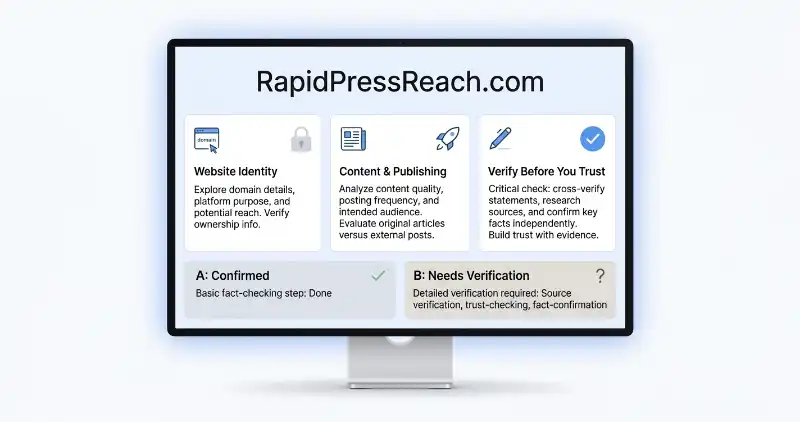
You may now have a basic idea of RapidPressReach, but one important problem can still remain.
What if someone makes a claim about the website and you cannot find the same information yourself?
This is where you need a simple verification process. The goal is not to assume that every claim is false. It is to make sure you know which details are supported before you rely on them.
Compare the Website’s Own Information With Third-Party Listings
Start with the source making the claim.
If someone tells you that RapidPressReach accepts guest posts, check whether that information is also stated by the website itself.
If a marketplace lists certain categories, compare those categories with the website’s actual content.
This gives you two separate pieces of evidence:
- First-party information: What the website itself says.
- Third-party information: What another platform says about the website.
These sources can support each other, but they should not automatically be treated as identical.
For example, a publisher marketplace listing can show RapidPressReach under Finance, Health, and Technology. That is useful evidence about how that marketplace categorizes the domain. It does not, on its own, prove every publishing service someone may claim the website offers.
So when two sources agree, your confidence in that specific detail can increase.
When they do not agree, stop and investigate the difference.
Check the Domain, Contact Details, and Publishing Information
Next, look for information that connects the offer to the actual website.
Check the domain carefully.
Make sure the person contacting you is actually discussing RapidPressReach.com and not a similar-looking domain.
Then check whether the contact information, publishing instructions, and other details match the website or the platform through which the offer was made.
If someone asks you to pay for a publishing service, do not rely only on a screenshot or a short email.
Ask for the exact publication terms.
You should be able to understand:
- where the article will appear,
- what type of article it is,
- what links are allowed,
- what the total cost is,
- who is responsible for publishing it,
- and what happens if the publication does not happen.
These checks are simple, but they can prevent a misunderstanding later.
Separate Confirmed Information From Claims That Still Need Verification
This is probably the most useful habit when researching a website.
Make two lists.
Confirmed or supported information
These are details that you can connect to a reliable source.
Information that still needs verification
These are claims you have heard but cannot independently confirm.
For RapidPressReach, the available third-party evidence supports its appearance as a publisher listing with Finance, Health, and Technology categories.
Other online articles also show the domain being referenced in published content. That demonstrates an existing connection with online content, but it does not by itself establish every service that may be offered.
That distinction is important.
You do not need to label an unconfirmed claim as false.
Simply mark it as not yet verified.
That keeps your research accurate.
What Should You Do If RapidPressReach Information Is Unclear?
Sometimes you will reach a point where the available information does not give you a complete answer.
Maybe a person says guest posting is available, but you cannot find clear publishing instructions.
Maybe a third-party listing gives one description while another source gives something different.
Instead of guessing, deal with the exact missing information.
Identify Which Detail You Cannot Confirm
Do not treat the whole website as unclear just because one detail is missing.
Find the exact unanswered question.
For example:
Unclear: “I do not know whether RapidPressReach accepts guest posts.”
That is much better than:
Unclear: “I do not know anything about RapidPressReach.”
Now you know exactly what needs to be checked.
The same approach works for pricing, backlinks, article requirements, publication duration, or contact information.
Turn the general doubt into one specific question.
Avoid Assuming Unverified Services or Claims
This is especially important when money or website links are involved.
If someone tells you:
“RapidPressReach guarantees permanent publication.”
but you have not seen that condition in the actual terms, do not present it as a confirmed fact.
If someone says:
“You can publish any topic.”
but there are no clear guidelines supporting that statement, treat it as an unverified claim.
You can still ask for clarification.
This keeps you from making a decision based on information that may later turn out to be incomplete.
Find the Missing Information Before You Proceed
Once you know what is unclear, ask one direct question.
For example:
“Can you confirm whether this is a guest post or sponsored placement, and please provide the publishing and link requirements?”
That question is better than sending several vague messages.
If the response clearly answers your question, update your notes.
If the answer creates even more confusion, ask for the exact terms or documentation.
The aim is simple: do not move forward while an important part of the offer is still unclear.
What Can You Actually Confirm About RapidPressReach.com?
After checking the available information, you should now be able to separate useful evidence from assumptions.
That gives you a much clearer picture than simply reading a short description of the domain.
Confirmed Website Information
One supported piece of information is that RapidPressReach.com appears in a third-party publisher catalog and is categorized there under Finance, Health, and Technology.
The domain has also appeared as a reference in published online content. This supports the fact that RapidPressReach has an existing presence in web publishing and content references.
These are useful facts to keep.
But they should not be expanded into claims that the available evidence does not establish.
Information That Still Requires Direct Verification
Some details require a more direct check before you rely on them.
For example, if you want to know:
- whether guest posts are currently accepted,
- whether sponsored publications are available,
- what the current price is,
- which links are permitted,
- whether content must meet specific editorial rules,
- how long an article will remain published,
- or who officially handles publishing,
you should verify those details through the current publishing offer or the responsible website/contact source.
A third-party listing can help you discover a website.
It should not automatically be treated as the complete terms of a publishing agreement.
A Simple Checklist Before Using the Website
Before you proceed with any RapidPressReach-related publishing offer, run through this short checklist:
1. Domain check
Make sure the offer actually concerns RapidPressReach.com.
2. Service check
Know whether you are being offered a guest post, sponsored post, link placement, or another service.
3. Content check
Confirm the topic, word count, article format, and editorial requirements.
4. Link check
Ask how many links are allowed and what type of links can be included.
5. Payment check
Confirm the total price and payment terms before sending money.
6. Publication check
Ask where the article will appear and whether it is expected to remain live.
7. Evidence check
Separate information you can confirm from claims you have only been told.
8. Final decision check
If an important detail remains unclear, get an answer before proceeding.
This checklist gives you a practical way to handle the website without making assumptions.
FAQ About RapidPressReach.com
Is RapidPressReach.com associated with online publishing?
Available third-party evidence shows the domain appearing in a publisher catalog and being referenced in published online content. That supports its connection with web publishing, but the exact services available at any given time should be verified.
What topics are associated with RapidPressReach?
A third-party publisher listing places RapidPressReach.com under Finance, Health, and Technology. This describes the categories used by that listing and should not automatically be treated as a complete description of every article on the website.
Can I assume that RapidPressReach accepts guest posts?
No. A publisher listing alone is not enough to establish the current guest-post policy. If you are considering a placement, confirm the exact publishing service, requirements, pricing, and link rules first.
What should I do if someone offers me a RapidPressReach publication?
Ask for the exact terms before sending content or payment. Confirm the publication type, article requirements, links, price, publication location, and any conditions attached to the offer.
Why should I separate confirmed information from claims?
Because a third-party description may provide useful information without proving every claim about a website. Keeping confirmed facts separate from unverified claims helps you research RapidPressReach without making assumptions.

I’m James Carter, a professional writer at Meanexplainer.com, where I write about word meanings, slang, phrases, grammar, and everyday language.
I created my writing approach around one simple idea: understanding a word should be easy, practical, and useful. My articles go beyond basic definitions by explaining how words and phrases are actually used in conversations, texting, social media, and everyday writing.
At Meanexplainer.com I focus on turning confusing language questions into clear, straightforward answers. I regularly cover modern slang, commonly confused words, expressions, grammar, and the changing ways people communicate online.
My goal is to help readers find the right meaning, understand the context, and use words and phrases with confidence.


