
If you searched for techslassh.com, you probably want a simple answer first: what is this website, and what can you actually find there?
Techslassh presents itself as a website covering technology along with health, business, education, celebrity, lifestyle, fashion, and entertainment. So, despite the technology-focused name, it is not limited to tech news or gadget content.
Maybe you found the domain through Google and are now wondering whether it is a technology site, a general blog, or something else. You may also have noticed other websites with very similar names. Honestly, that can make the search a little confusing.
This article breaks that confusion down one part at a time. We will first identify what techslassh.com actually is, then look at its content and similar domains. After that, we will deal with the separate questions about safety, reliability, and how much you should trust the information you find there.
What Is Techslassh.com and Why Does Its Name Create Confusion?
If you are expecting a normal technology website because of the name TechSlassh, the first thing to understand is that the name does not tell the whole story.
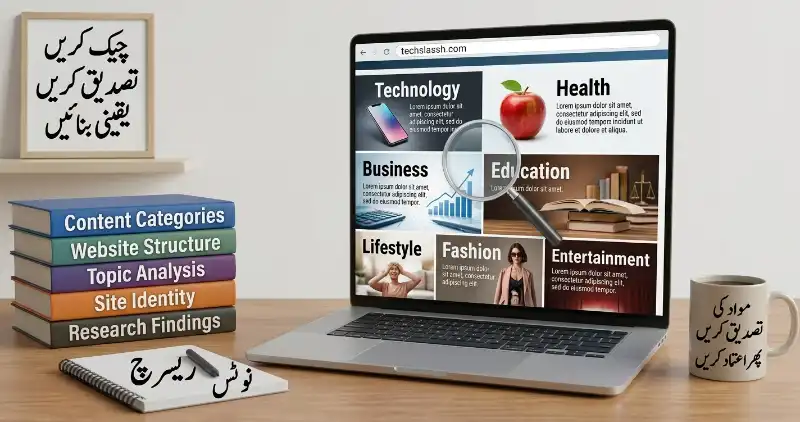
The exact domain, techslassh.com, is an online publishing website. Its own About Us page says it covers several areas, including Technology, Health, Business, Education, Celebrity, Lifestyle, Fashion, and Entertainment. It says its goal is to provide news, trends, insights, and other content across these subjects.
So if you landed on the site looking for technology information, you are in the right place as far as the domain is concerned. But you should not assume that every page will be about computers, smartphones, software, or artificial intelligence.
There is another reason the name can cause confusion: similar Techslassh domains exist online.
Search results currently show other websites using names such as thetechslassh.com, techslassh.com.co, and techslasshcom.com. These are separate domain names. A similar spelling does not prove that they belong to the same publisher.
That is why the exact domain matters.
If your search was specifically for techslassh.com, do not take information from another Techslassh-looking domain and automatically apply it to this website.
The simple answer: Techslassh.com is a multi-topic online publication with a strong technology identity. It is not simply a software product, app, or online technology tool.
Is Techslassh.com Actually a Technology Website or a General Content Site?
This is probably the biggest point of confusion once you open the site.
You see “TechSlassh” and naturally expect technology to be the main subject. And technology is clearly part of the site’s focus. Its About page mentions gadgets, software updates, AI innovations, apps, and devices under its Technology section.
But the same site also openly lists several non-technology categories.
Its stated coverage includes:
- Technology
- Health
- Business
- Education
- Celebrity
- Lifestyle
- Fashion
- Entertainment
The site’s current pages support that broader picture. For example, its Technology section contains technology-related material, while its Education and Lifestyle areas cover subjects outside traditional tech news.
So which description is correct?
Both parts are important.
It is reasonable to call Techslassh.com a technology-focused publication because technology is a major part of its identity and content. But calling it a technology-only website would leave out a large part of what the site actually publishes.
This distinction matters if you came to the site for a specific reason.
Imagine you searched for information about an AI tool. You may find a technology article that fits your search. But if you then browse the site and see education, health, business, fashion, or celebrity content, that does not mean you have reached the wrong domain.
It simply means the publication has a broader content model.
So, if your question was “Is Techslassh.com only a tech website?”, the answer is no.
It has a technology identity, but it also publishes across several other categories.
Are Techslassh.com and Similar Techslassh Domains the Same Website?
If you have seen several websites with almost the same name, slow down before assuming they are connected.
This is one of those situations where one missing letter, an extra word, or a different domain extension can point to an entirely different website.
For example, current search results show:
- techslassh.com
- thetechslassh.com
- techslassh.com.co
- techslasshcom.com
These domains have similar names, but they are not the same web address. Their pages also describe different site identities and content models.
That means you should not combine their information.
Why a Similar Domain Name Does Not Prove the Same Ownership
A website name is not enough to establish who operates a site.
Two publishers can use very similar words in their domains. One might focus entirely on technology, while another might publish technology, health, business, and lifestyle content.
For example, thetechslassh.com describes itself as a technology-focused site covering gadgets, software reviews, training programs, guides, and digital trends. That description is different from the broader category list published by techslassh.com.
This is exactly why it is risky to read a page about one domain and assume it describes another.
How to Confirm You Are on the Exact Techslassh.com Website
Before trusting a page, look at the address bar.
You want to see:
techslassh.com
Do not treat these as interchangeable:
thetechslassh.com
techslassh.com.co
techslasshcom.com
Then check the site’s own About and Contact pages.
The official Techslassh.com pages currently describe a multi-category publication and list contact details including an email address, phone number, and an address in Alpharetta, Georgia.
This does not prove everything about ownership or editorial quality, but it helps you confirm which website you are actually reading.
So the problem is now solved: similar names should be treated as separate websites unless there is clear evidence showing a connection.
Why Does Techslassh.com Publish Content Outside Technology?
Once you know that Techslassh.com covers more than technology, another question naturally comes up:
Why does a website called TechSlassh publish health, education, fashion, business, and entertainment content?
The important thing here is not to invent a reason that the publisher has never confirmed.
The site’s About Us page openly describes its mission as covering multiple industries. It specifically presents the site as a place for readers interested in technology, health, business, education, celebrity, lifestyle, fashion, and entertainment.
So the mixed content itself is not a mystery that needs a hidden explanation.
It is part of the site’s stated publishing model.
There is also evidence that the site accepts contributions. Its Write For Us page invites writers to submit articles and lists technology subjects such as software development, gadgets, technology news, tutorials, and business technology. It says submitted articles are reviewed for quality, relevance, and originality before publication.
That helps explain why readers may encounter different authors and different writing styles.
But there is an important limit.
We can verify that the site has a broad category structure and accepts contributions. We cannot automatically say why every individual article was published, or claim that a particular article exists because of an SEO strategy, paid placement, or another reason unless there is evidence for that specific claim.
That distinction keeps the answer fair.
What the Mixed Content Means for You
If you came to Techslassh.com expecting only technology news, adjust your expectation.
The site is better understood as a multi-topic publication with technology as one of its main areas.
That does not automatically make its technology articles good or bad. It simply tells you not to judge an individual article only by the site’s name.
For example, if you find an article about an AI tool, evaluate that article on its own:
- Who wrote it?
- When was it published?
- Does it provide sources?
- Are the claims current?
- Can important facts be confirmed elsewhere?
Those questions become more important once you move from “What is this website?” to “Can I trust what this particular article says?”
And that is a different problem.
We will deal with that next, along with the separate question of whether techslassh.com is technically safe to visit.
Is Techslassh.com Safe to Visit?
If your concern is simply, “Can I open techslassh.com without putting my device or personal information at unnecessary risk?”, that is a different question from whether the site’s articles are accurate.
The site uses HTTPS, which means the connection between your browser and the website is encrypted. A current PCrisk scan also reported a valid TLS certificate and found that none of the 91 security engines it checked flagged the domain at the time of the scan.
That is a positive technical sign, but it does not mean you should trust every link or download you see on the site.
For normal browsing, the basic rules still apply. If your browser shows a security warning, stop. If a page suddenly redirects you somewhere unexpected, close it. And if a page asks for passwords, payment details, or other sensitive information without a clear reason, don’t rush to provide it.
There is also another reason to be careful with external links. PCrisk reported more than 1,300 external links in its June 2026 scan and identified 26 referenced domains as suspicious or malicious by its automated checks. The report also says these findings can include false positives or incomplete results.
So the practical answer is not “the site is perfectly safe” or “the site is dangerous.”
The available evidence shows normal HTTPS protection and no broad threat detection in that particular scan, while the large number of flagged external references gives you a reason to be more careful when clicking links that take you away from the main domain.
What Do Independent Security Checks Say About Techslassh.com?
If you do not want to rely only on the website’s own pages, independent scanners can give you another piece of evidence.
But there is an important catch: these services check different things. Their results should be read as technical signals, not as a final judgment about everything published on the website.
What ScamAdviser Reports
ScamAdviser currently describes techslassh.com as “Very Likely Safe.” Its report points to a valid SSL certificate and a safe result from DNSFilter.
At the same time, the report lists some limitations. It says the site’s WHOIS ownership information is hidden, the domain has relatively few visitors, and the domain was registered recently. ScamAdviser also says its own scan had not been updated for more than 30 days when the page was checked.
Those details should not automatically be treated as proof that something is wrong.
For example, domain owners can use privacy services for ordinary privacy reasons. A newer website can also naturally have fewer visitors than an older one.
So ScamAdviser’s information is best understood as a collection of reputation and technical signals.
What PCrisk Reports
PCrisk’s June 10, 2026 scan gives another view.
It reported 0 out of 91 threat engines flagging the domain and said the checked threat databases did not list it at that time. It also confirmed a valid TLS certificate.
However, the same scan reported 26 flagged external domains and 52 flagged resources among the pages and links it examined. PCrisk itself notes that its results are based on a point-in-time automated scan and can contain false positives or incomplete information.
That difference is worth noticing.
One part of the scan gives a generally clean domain-level result, while another part identifies potentially concerning external references.
What These Security Results Actually Tell You
They tell you something about the website’s technical and reputation signals.
They do not tell you whether an article about AI is accurate.
They do not prove that a health claim is medically sound.
They do not prove that a product recommendation is unbiased.
And they do not tell you whether every external website linked from an article is trustworthy.
So if your question was “Does a security scan prove that Techslassh is reliable?”, the answer is no.
It only answers part of the bigger question.
Does a Secure Techslassh.com Website Mean Its Information Is Reliable?
This is an easy mistake to make.
You see HTTPS in the browser, perhaps a padlock, and maybe a favorable security scan. It can feel like the whole website has been checked and approved.
It has not.
HTTPS protects the connection. It does not fact-check the words on the page.
Techslassh’s own disclaimer makes this distinction important. The site says it is not responsible for actions taken based on its information. It also says that external websites are not controlled by TechSlassh and that users access those sites at their own risk.
The disclaimer also says TechSlassh may publish affiliate links and sponsored content. It says the site does not guarantee the quality, effectiveness, or suitability of products or services offered by third parties.
That does not mean an article is automatically wrong.
It simply means you should not use “the website has HTTPS” as your only reason for trusting a claim.
Think of it this way:
Security asks: “Is the connection protected?”
Reliability asks: “Is this information accurate and supported?”
Those are two different questions.
Once you understand that difference, evaluating the site becomes much easier.
Can You Trust a Techslassh.com Article Without Checking Its Source?
If you found an article that looks useful, you do not need to reject it just because Techslassh covers many different subjects.
Instead, judge the specific article.
Start with the author.
Current Techslassh articles show different bylines. Recent pages, for example, include articles credited to Bhairavi Chowdhury and Alfa Team.
That alone does not tell you whether an article is good or bad. But it does tell you that you should look at who actually wrote the piece before treating it as expert advice.
Why the Author and Date Matter
A technology article can become outdated surprisingly fast.
A software feature can change. A company’s policy can change. A product can be discontinued. A security problem can be fixed.
So check:
- Who wrote the article?
- When was it published?
- Has it been updated?
- Does the author appear to have relevant knowledge?
- Does the article provide sources?
For a simple opinion or general-interest article, you may not need extensive verification.
For something that could affect your money, health, education, job, privacy, or security, the standard should be higher.
Why the Original Source Matters More for Important Claims
Suppose an article says a government has changed an education rule.
Instead of stopping at the article, find the government department or official education authority.
If it discusses a company’s product, check the company’s official documentation.
If it makes a health claim, look for a recognized medical or public-health source.
This gives you a much stronger basis for making a decision.
So you can read Techslassh to understand a topic, but when the information matters, move one step closer to the original source.
What Should You Do If a Techslassh.com Article Makes a Claim You Cannot Verify?
This is where you can turn uncertainty into a simple process.
Imagine you read a statement that sounds important, but there is no clear source and you cannot find the same information elsewhere.
Do not immediately call it false.
But do not treat it as confirmed either.
Step 1: Identify the Exact Claim
Forget the rest of the article for a moment.
Ask yourself:
“What exact statement am I trying to verify?”
A smaller claim is much easier to check than an entire article.
Step 2: Check the Date
Look at when the article was published.
If the information concerns software, laws, jobs, prices, education rules, or current events, an old page may no longer reflect the current situation.
Step 3: Look for the Original Source
Check whether the article links to:
- an official organization
- a government website
- a company
- a university
- a research paper
- another identifiable primary source
If it does, follow that source and see whether it actually supports the claim.
Step 4: Compare Important Information
For something important, check at least one reliable independent source.
If two credible sources agree, you have stronger evidence.
If they disagree, look at their dates and original evidence before deciding what to believe.
Step 5: Do Not Act on an Unverified High-Stakes Claim
This is the part people sometimes skip.
If the claim could cost you money, affect your health, change an education decision, affect your job, or expose your personal information, wait until you can confirm it.
You do not have to solve every uncertainty immediately.
Sometimes the correct next step is simply “I need better evidence first.”
Does Techslassh.com Publish Content From Different Contributors?
If you notice different names and writing styles on the site, there is a straightforward reason to consider: Techslassh has a public Write For Us page.
The page says it welcomes writers at different experience levels and accepts technology-related contributions. It asks for original, well-researched, useful content and says submissions are subject to its guidelines.
This is useful context when reading the site.
Different contributors can bring different experience, writing styles, and levels of subject knowledge. That does not mean contributor articles are automatically unreliable.
In fact, Techslassh’s own submission guidelines say that articles should be original, well-researched, and supported by credible sources.
The better lesson is simply this:
Do not assume that every article has the same author, background, or expertise.
If an article makes an important claim, evaluate the article itself.
That approach is much fairer than judging every page only by the domain name.
What Is the Right Way to Use Techslassh.com?
If you have reached this point, the practical question is probably simple:
“So, should I use Techslassh.com or not?”
You do not need an all-or-nothing answer.
Techslassh.com can be useful for discovering information, reading general-interest articles, finding ideas, and learning about different topics. Its own website shows that it publishes across technology and several other categories.
The part that needs more care is when an article asks you to believe something important or act on it.
For example, be more careful when the information concerns:
- health decisions
- financial decisions
- education rules
- jobs and career opportunities
- software security
- personal data
- expensive products or services
In those cases, use the article as a starting point, then check the original or most authoritative source you can find.
That gives you a simple way to use the website without either blindly trusting it or rejecting everything on it.
FAQ: Questions Readers May Still Have About Techslassh.com
Does Techslassh.com collect personal information?
Its privacy policy says the site may collect information such as names and email addresses when users voluntarily provide them through newsletters, contact forms, surveys, or contests. It also says it may collect browsing-related information such as browser type, device type, IP address, and pages viewed.
Does Techslassh.com use affiliate or sponsored content?
Yes. Its disclaimer says the site may contain affiliate links and sponsored content and that it may earn a commission when users make purchases through affiliate links.
Can Techslassh.com guarantee that third-party products or services are good?
No. Its disclaimer specifically says it does not guarantee the quality, effectiveness, or suitability of products and services offered by third parties.
Why can two Techslassh articles have different writing styles?
The site accepts contributions from writers, and current articles show different bylines. Different authors can naturally produce different styles and levels of subject expertise.
Final Takeaway
If you searched techslassh.com because you were unsure what the website actually is, the picture should now be clearer.
Techslassh.com is a multi-topic online publication with a strong technology focus. Its own pages also show coverage of health, business, education, lifestyle, fashion, celebrity, and entertainment.
The exact domain also matters because similarly named websites exist. A similar spelling does not mean two sites have the same owner or editorial identity.
As for safety, current technical checks show some positive signs, including HTTPS and no detection by the 91 threat engines used in the June 2026 PCrisk scan. At the same time, that scan identified many flagged external references, so links leading away from the site deserve normal caution.
Most importantly, technical security is not the same as information reliability.
You can read Techslassh to learn about a topic or discover useful information. But when a claim could affect your money, health, education, career, privacy, or security, take the extra step and verify it with a reliable or primary source.
That is the practical answer: know which Techslassh domain you are using, understand what kind of publisher it is, and judge important information at the article and source level rather than trusting or rejecting the whole website at once.

I’m James Carter, a professional writer at Meanexplainer.com, where I write about word meanings, slang, phrases, grammar, and everyday language.
I created my writing approach around one simple idea: understanding a word should be easy, practical, and useful. My articles go beyond basic definitions by explaining how words and phrases are actually used in conversations, texting, social media, and everyday writing.
At Meanexplainer.com I focus on turning confusing language questions into clear, straightforward answers. I regularly cover modern slang, commonly confused words, expressions, grammar, and the changing ways people communicate online.
My goal is to help readers find the right meaning, understand the context, and use words and phrases with confidence.


